Export DBF to JSON (2026 Update)
JSON stands for JavaScript Object Notation and is an open standard for data exchange between web applications. This format is often used as a way to provide input data to various web applications or as a way to store data in a number of free and commercial databases.
Why Use DBF Viewer 2000 to Export to JSON?
DBF Viewer 2000 makes DBF-to-JSON conversion simple and controlled. You do not need to write scripts, install database drivers, or manually rebuild the table structure. The program opens DBF files directly and lets you export the data in a clean JSON format for web apps, databases, migration tasks, and data exchange.
The main advantage is flexibility. You can export the entire table or only selected columns, skip records marked as deleted, apply filters, reorder fields, and limit the export to a specific record range. This is helpful when you need a smaller JSON file or want to prepare data for a specific system.
For users who prefer a visual workflow, the GUI provides a clear export dialog. For administrators and developers, the command-line options enable DBF-to-JSON conversion in scripts, batch files, and scheduled tasks.
Step-By-Step Instructions for Exporting to JSON
Step 1. Open your DBF file
Start DBF Viewer 2000 and open the table you want to convert. Use the File | Open menu and select the required DBF file from your computer.
Step 2. Select the Export command
Go to File | Save as/Export. In the export window, choose JSON as the output file type.
Step 3. Select fields for export
The program will show a list of fields from the source DBF file. Select the fields you want to include in the JSON file. You can also change their order by using the up and down arrows.
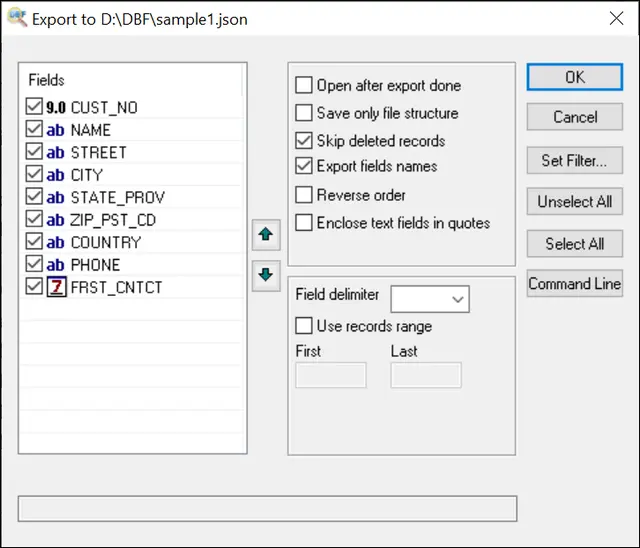
You can adjust a number of options too:
- Open after export is done. If enabled, the resulting JSON file will be opened automatically in the associated application.
- Save only file structure. This option allows you to ignore all data stored in the DBF, and to export only its header structure.
- Skip deleted records. If enabled, the program will not export DBF records that are marked as deleted.
- Export fields names. If on, field names are exported to JSON too.
- Reverse order. Enable this option to export records of the original DBF file in the reverse order, from bottom to top.
- Use records range. This option allows you to limit exporting with a certain range of records.
- Set filter. Click this button to bring up the filtering dialog. This allows you to export from DBF to JSON only those records that match the filter conditions.
DBF to JSON Command Line
Simple Export
Export in reverse mode
Export with selected columns
Export with Sorting
Export Files in subdirectories to JSON
FAQ
Can I export only selected DBF fields to JSON?
Yes. During manual export, you can choose which fields to include in the JSON file and arrange them in the desired order.
Can I export only certain records?
Yes. DBF Viewer 2000 allows you to use filters and record ranges. This means you can export only the data you actually need, rather than converting the entire DBF table.
Can deleted DBF records be skipped?
Yes. Enable the Skip deleted records option if you do not want records marked as deleted to appear in the exported JSON file.
Do you need other options for JSON generation?
Please, contact us by E-mail: support@dbf2002.com or by On-line form.